Seen to Be Useful: Building Credibility in a Hybrid Team Without Performing Busyness
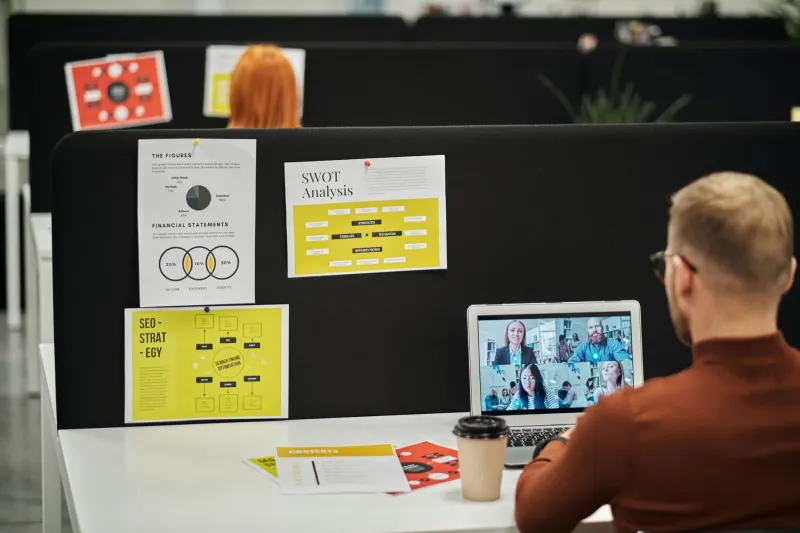
In a hybrid team, good work does not always travel. A difficult problem resolved on a quiet Thursday may never reach the people whose judgement matters. The temptation is to compensate by appearing ever-present: quick replies, visible status updates, long hours online. That is performing busyness, and it rarely builds the kind of credibility that survives a change of project or manager. A more durable approach is to design visibility into the way you work.
Visibility is a design problem, not a performance
Many UK organisations now treat the office as a place for meetings and the home as a place for focused work. That split has advantages, but it also creates proximity bias: those who are seen are assumed to be contributing more. The answer is not to abandon deep work in favour of constant broadcasting. It is to make the outputs of your work legible to people who were not present when it happened.
Credibility in a hybrid team rests on three things: decisions that can be traced, contributions that can be understood without a meeting, and relationships that do not depend on sharing a corridor. Each can be handled deliberately.
Document decisions while they are still warm
A decision that exists only in a meeting has a short half-life. Within a week, people remember that something was agreed but not what, by whom, or by when. The practical remedy is a short written record, produced soon after the conversation.
This need not be formal minutes. Three lines in a shared channel are usually enough: the decision, the owner and the date. Add the reasoning in one sentence if the decision is likely to be revisited. The purpose is not to create paperwork but to give absent colleagues a reliable point of entry.
A useful habit is to end any significant discussion with a written summary posted where the wider team can see it. This signals that you are organised, but more importantly it creates a shared reference that reduces repeated questions and misinterpretation. Over time, the person who consistently produces clear records becomes the person others turn to for orientation.
Make asynchronous contributions easy to use
In hybrid teams, much of your influence is exercised in writing. A message that buries the request in three paragraphs of context will be read late or not at all. A message that leads with the ask, follows with the minimum necessary context and states a deadline is more likely to get a useful response.
The same principle applies to documents and proposals. State the recommendation first, then the evidence. Use headings and short paragraphs. If a colleague has five minutes between meetings, your contribution should still be usable. This is not dumbing down; it is respecting the conditions under which people actually read.
There is a credibility benefit here that is easy to overlook. Clear writing demonstrates clear thinking. Colleagues who have never met you in person will form a judgement from how you structure an argument, how quickly you get to the point and whether your conclusions are supported. Asynchronous clarity is a form of professional presence.
Share credit with specificity
In UK workplaces, self-promotion can feel awkward, and many professionals under-report their own contribution as a result. One way to build visibility without boastfulness is to become known as someone who credits others accurately.
Replace general statements such as the team did well with specific ones: who analysed the data, who handled the client conversation, who spotted the risk. Specific credit is more credible than broad praise, and it encourages others to reciprocate. It also positions you as someone who notices the work rather than merely the outcome.
This matters for influence. People are more willing to support colleagues who are seen to be fair. Deliberate credit-sharing is not a soft gesture; it is a practical way of building the alliances that make future work easier to deliver.
Influence the room you are not in
Hybrid working has not removed the importance of decisions made in rooms, but it has changed who is able to shape them. If you cannot be present, your reasoning can still be. A short written note before a decision meeting, setting out your view and the evidence behind it, is often more effective than a verbal contribution made under time pressure.
Similarly, a brief follow-up note after a meeting you did attend can help colleagues who were absent understand what changed and why. The aim is not to be in every conversation but to ensure your perspective is available when it matters.
This requires some judgement. Pre-briefing can become lobbying if it is handled clumsily. Keep it factual, share it with the relevant people and avoid framing it as a contest. The professional version is simple: here is the position, here is the evidence, here is what I recommend.
Keep an honest record of contribution
Visibility is easier to sustain when you have evidence. A contribution log, updated fortnightly, can record outcomes rather than hours: problems resolved, risks surfaced, colleagues supported, decisions influenced. This is not a vanity file. It is a useful input for appraisals, promotion conversations and, if necessary, a reminder to yourself that quiet work still counts.
The log should be honest. If a project slipped, note why and what changed. Credibility is damaged more by inflated claims than by acknowledged setbacks. A record that includes difficulties is more persuasive than one that does not.
The line between visibility and busyness
Busyness signals are easy to produce and easy to see: rapid replies, long hours, constant updates. Credibility signals are quieter but more durable: decisions made, risks surfaced, colleagues supported and work delivered. The first set may attract attention in the short term, but the second set earns trust.
The distinction matters for wellbeing as well as reputation. Performing visibility as a full-time activity leaves little room for the work that justifies it. Designed visibility, by contrast, takes minutes rather than hours: a written summary, a clear message, a specific acknowledgement.
For UK professionals in hybrid teams, the goal is not to be seen constantly. It is to be seen accurately. Document what matters, write so that absent colleagues can understand it, credit people precisely and make your reasoning available when you cannot be in the room. That is not self-promotion. It is professional communication, and it is increasingly what good work looks like.