The Last Two Minutes: Seven Closing Lines That Get Quiet Teams Talking

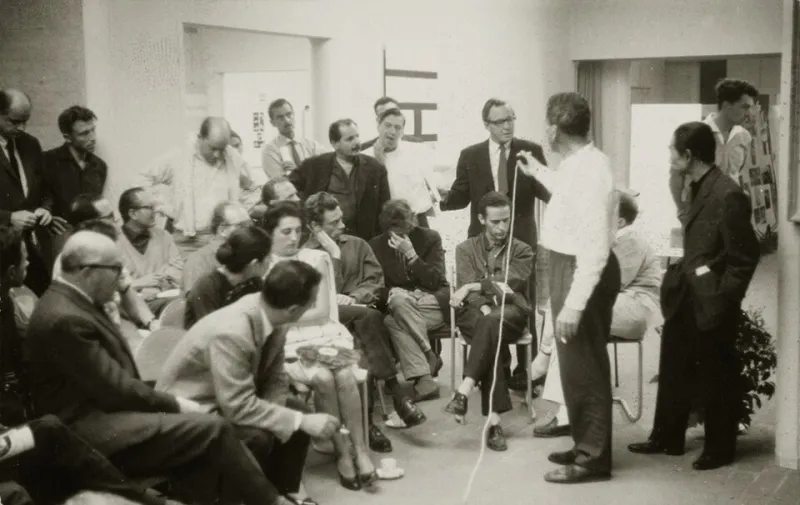
Photo: Dialh, CC BY 4.0, via Wikimedia Commons
There is a particular sound a UK team meeting makes when it ends. Not silence exactly, but the rustle of notebooks closing, the scrape of a chair, a murmured 'right, thanks everyone'. Somewhere in the middle of that, the chair has asked whether there are any questions, and nobody has answered. The question has been asked and answered by the asking.
This is not a failure of intelligence or engagement. It is a failure of wording, and wording is learnable. Closing a meeting is a skill, not a personality trait, and the difference between a room that talks and a room that files out politely is often a single sentence.
Why 'any questions?' reliably produces nothing
The phrase fails for four predictable reasons.
First, it arrives too late. By the time it is asked, the meeting is mentally over. Attention has moved to the next appointment, the train, the school pick-up. The invitation is genuine but the moment has gone.
Second, it diffuses responsibility. An open invitation to a group invites everyone to assume someone else will speak. Silence becomes a collective decision that no individual has to own.
Third, it asks for a category of contribution that British workplace norms quietly discourage. To ask a question at the end is to extend the meeting for everyone, to imply that the preceding forty minutes were insufficient, or to risk looking as though you have not kept up. Most people will choose not to make a fuss.
Fourth, it is too broad to answer. Vague invitations produce vague responses. A specific question gives a hesitant contributor something to hold on to.
What a good closing line actually does
Every line below works because it does at least one of four things: it narrows the question so that answering is easy, it grants explicit permission to speak, it sets a time boundary so nobody fears an open-ended extension, or it offers a channel other than voice. Use them as written at first. Once they feel natural, adapt them.
1. 'Before we finish — what have I got wrong?'
The script: 'One last thing. I have made a few calls in this meeting. What have I got wrong, or what am I not seeing?'
The rationale: This transfers the risk of speaking from the team member to the chair. It concedes fallibility before anyone has had to challenge you, which removes the awkwardness of appearing to criticise a manager. It also produces better information than any variant of 'does anyone have concerns?', because it invites correction rather than opinion.
When it backfires: In a very new team, or one where trust is genuinely low, it reads as a trap. If the first person brave enough to answer is met with a defence of your original decision, the line will never work again. Take the answer, thank the person, and move on.
2. 'Name one thing that will slow you down this week.'
The script: 'Quick round: one thing each that is likely to get in the way this week. I will take the actions away.'
The rationale: This asks for a fact rather than a judgement. Facts are safer to offer than opinions, and the question has a built-in justification for speaking: you are not complaining, you are supplying data. It also surfaces friction before it becomes a missed deadline.
When it backfires: In groups larger than eight, the round becomes a lecture series. Split the room, or collect it in writing afterwards.
3. 'Who disagrees but hasn't said so yet?'
The script: 'I suspect not everyone is convinced by this. Who wants to put the other side, even if only partly?'
The rationale: Silence in a meeting is frequently not agreement, and everyone present usually knows it. Naming the unspoken dissent gives it a legitimate home. The qualifier 'even if only partly' matters: it allows someone to raise a concern without committing to full opposition.
When it backfires: Used repeatedly on the same team, it becomes a performance expectation, and people begin to manufacture objections to seem engaged. It also fails if the decision is genuinely closed. Do not ask the question if you are not prepared to reopen the answer.
4. 'One sentence each, starting with the words "I need".'
The script: 'We will finish with one sentence each, and I would like it to start with "I need".'
The rationale: Structure equalises airtime. The confident contributor cannot dominate a sentence of fixed length, and the quieter contributor is not required to construct an argument from scratch. The constraint does the work that a general invitation cannot.
When it backfires: With teams unaccustomed to it, the first attempt feels self-conscious and produces stilted answers. Run it for three consecutive meetings before judging it. Avoid it in meetings where several people are joining by video from a shared room, where the round is easy to lose track of.
5. 'What is the smallest thing we could change before next week?'
The script: 'Not the big fix. The smallest thing we could alter before we next meet.'
The rationale: Ambition is intimidating and, in many British workplaces, faintly embarrassing to propose out loud. Asking for the smallest change lowers the stakes of contributing and produces commitments people will actually keep. Small offers also give you evidence of who thinks practically.
When it backfires: If nobody ever escalates from the small change to the substantial one, the team develops a habit of tinkering. Follow up in a later meeting with 'what has the small change taught us?' rather than accepting the small change as the endpoint.
6. 'I will be at my desk until half four — send me the thing you did not want to say in the room.'
The script: 'If something occurred to you that you would rather not raise in front of everyone, message me before half four. No explanation needed.'
The rationale: Some contributions will never be made aloud, and no amount of chairing skill will change that. Offering an asynchronous channel is not a defeat; it is an acknowledgement that voice is not the only route to honesty. It is particularly useful in hybrid teams, where the awkward silence is spread across a screen.
When it backfires: If you do not visibly act on what arrives, the channel closes permanently and people conclude, reasonably, that the offer was decorative. Acknowledge every message within a day, even when the answer is no.
7. 'What have we decided that we have not actually decided?'
The script: 'Before we close — is there anything we have all nodded at that is still, in fact, unresolved?'
The rationale: False consensus is the most expensive thing a meeting can produce. This line catches the moment when a room agrees to a direction that nobody has the authority or the information to agree to. It also gives the person who spotted the gap a way to raise it without appearing to have been inattentive throughout.
When it backfires: It can undo progress at the close of a well-run meeting, so use it before the actions are read out, not after. It also requires a chair who can hold the resulting re-opening without irritation.
Practising the close
Choose one line and use it for a month. Rotate it only when it has become so familiar that the team answers automatically. Note who speaks after each version, because the pattern will tell you something about the room that no engagement survey will.
Follow up within twenty-four hours. A closing line is an opening, not a resolution, and the follow-through is what converts a clever sentence into a habit of speaking. Two minutes at the end of a meeting is the cheapest piece of performance management available, and it is almost entirely a question of wording.